

Life Science Genealogy on Demand Released Showing Spin-off Companies from Universities, Non-Profits and Federal Agencies

LifeScienceHistory.com Logo
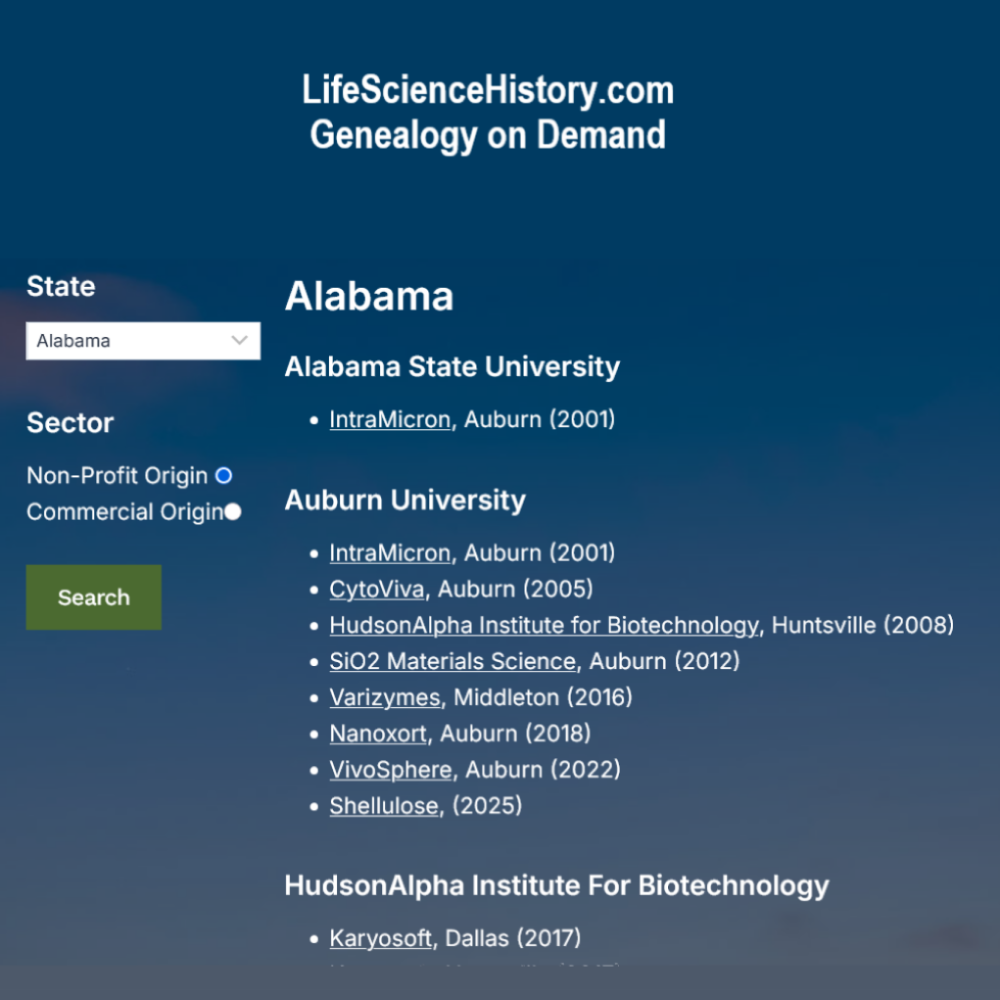
Life Science Genealogy on Demand
Explore the leading research universities, non-profit organizations and federal agencies driving life science innovation in North America.
It allows you to see the depth, and breadth of the industry in any state or province, and how important continued federal funding is to innovation development, company spin-offs and job creation.”
SEATTLE, WA, UNITED STATES, June 23, 2026 /EINPresswire.com/ -- LifeScienceHistory.com announces the release of its one-of-a-kind ‘Genealogy on Demand’ that illustrates companies founded on technology licensed from universities, non-profit research organizations and federal laboratories by U.S. state and Canadian province. — Philip Ness
Life Science Genealogy was developed by Phil Ness, publisher of LifeScienceHistory.com, when he created genealogy posters to communicate with the Legislature in the state of Washington about the then nascent biotechnology industry and its contribution to the state’s economy.
“For economic and technology development, the genealogy poster is a very effective communication tool providing a snapshot of the industry in a family-familiar format.” said Ness, “It allows you to quickly see the depth, and breadth of the industry in any given state or province, and how important continued federal funding is to innovation development, company spin-offs and job creation.”
In 1980, the U.S. Congress passed the Bayh-Dole Technology Transfer Act, a landmark piece of legislation that permits universities, non-profit organizations and private companies to own and profit from intellectual property developed with federal funding, incentivizing commercialization of discoveries and fostering economic growth.
Today, technology transfer offices, innovation centers and specialized lab-equipped incubators are common at universities, non-profit research organizations and federal labs across the U.S. and Canada. These offices are the gateway for companies licensing technology developed within their respective research institutions.
Data from the Association of University Technology Managers shows that from 1996 to 2020 more than 149,000 patents were issued with 69% going to start-ups and small companies and creating more than 200 plus drugs and vaccines through public-private partnerships.
LifeScienceHistory.com is owned and published by Info.Resource, a Seattle based company, established in 1997, that previously owned and published a network of state- and Canadian province-based life science web sites.
LifeScienceHistory.com has incorporated the previous networks localized state- and provincial-data into a rapidly growing resource of 20,000 plus pages of page flipping history making news, company information with a one-of-a-kind Genealogy on Demand, original cartoons, an original “Earth is a Rock, Let the DNA Mold Me” song and video celebrating science and scientists everywhere, plus more.
Philip Ness
LifeScienceHistory.com
+1 541-593-0291
phil@lifesciencehistory.com
Visit us on social media:
LinkedIn
Instagram
Facebook
YouTube
Legal Disclaimer:
EIN Presswire provides this news content "as is" without warranty of any kind. We do not accept any responsibility or liability for the accuracy, content, images, videos, licenses, completeness, legality, or reliability of the information contained in this article. If you have any complaints or copyright issues related to this article, kindly contact the author above.
