

AndaSeat Highlights Kaiser 4 as Cross-Platform Gaming Reshapes the Physical Gaming Setup
Kaiser 4
Kaiser 4
AndaSeat Highlights Kaiser 4 as Cross-Platform Gaming Reshapes the Physical Gaming Setup
SPOKANE, WA, UNITED STATES, November 4, 2026 /EINPresswire.com/ -- AndaSeat is highlighting the upgraded Kaiser 4 Series during its November 1–29 Black Friday campaign as the gaming industry moves toward a more platform-flexible model in which players, games and communities increasingly extend across PCs, consoles and handheld devices. The shift creates a practical furniture-design question that software cannot solve: when the device changes, the physical relationship among the player, arms, backrest and desk changes with it.Cross-platform development has become a significant industry priority in 2026. Unity’s 2026 Game Development Report found that 72% of surveyed developers are prioritizing cross-play functionality, while gaming handhelds accounted for 16% of developers’ planned next-platform expansion, ahead of traditional consoles at 13%. Boston Consulting Group has similarly identified platform convergence as one of the trends reshaping gaming as traditional boundaries among PC, console and mobile experiences weaken.
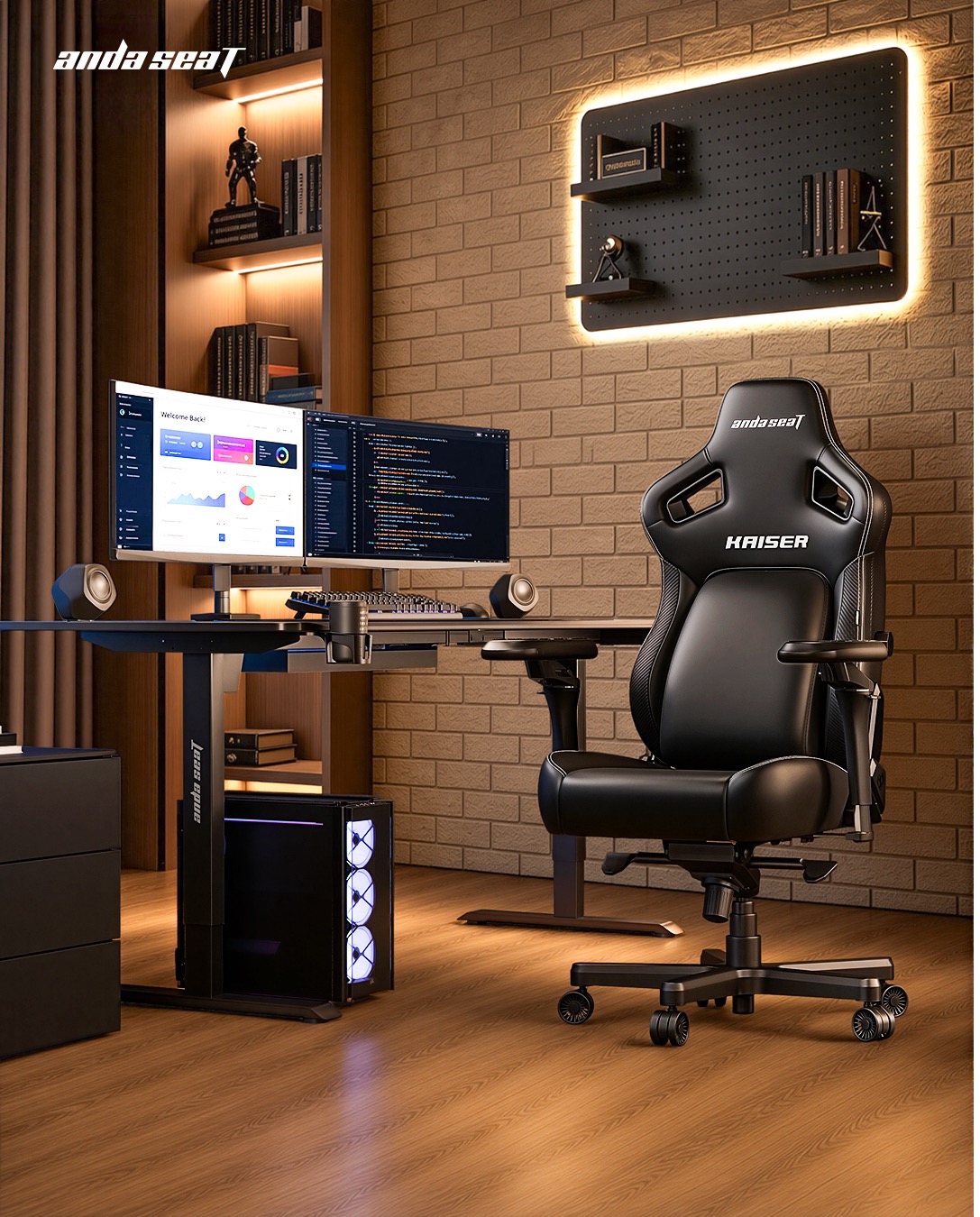
The result is a gaming environment in which the same player may use a desk-mounted keyboard and mouse for one title, a controller for another and a handheld device elsewhere in the same room. The game library may increasingly travel across hardware, but the physical setup still has to accommodate changing arm positions, viewing habits and seated states.
Kaiser 4’s upgraded 6D armrests and gas-spring-powered lumbar system address that problem from two different directions: the armrests change how the upper body relates to the input device, while the lumbar system changes how the chair supports different seated configurations.
Cross-Platform Gaming Creates a Physical Positioning Problem
Platform convergence is usually discussed in software terms: cross-play, shared accounts, cloud access and broader device support. Less attention is given to what happens to the body when the same player moves among those platforms.
Keyboard-and-mouse use typically keeps the hands forward on a desk surface. Public workstation guidance from OSHA and the Canadian Centre for Occupational Health and Safety recommends positioning keyboards and pointing devices so the elbows can remain relatively close to the body and unnecessary reaching is reduced. Those recommendations apply to computer work rather than gaming specifically, but they illustrate an important physical principle: input-device location directly changes arm and shoulder positioning.
Controller and handheld use create a different geometry. The hands are no longer anchored to fixed points on the desktop, allowing the forearms to move inward, downward or closer to the torso. Reclined gaming changes that geometry again because the user’s relationship to both the desk and armrests shifts as the backrest moves.
That means a chair designed around one permanent elbow location can become less adaptable as gaming itself becomes less tied to one device.
Kaiser 4 approaches this as a positioning problem rather than a platform-specific one.
6D Armrests Translate Device Changes Into Seating Changes
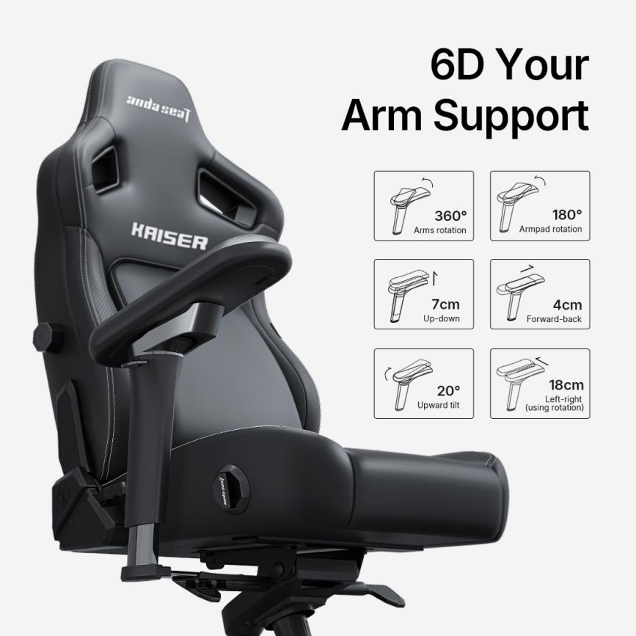
The upgraded Kaiser 4 moves from the earlier 5D armrest configuration to a 6D system with 180-degree arm-pad rotation, full-arm rotation, a 20-degree upward tilt, 7 cm of vertical travel and 4 cm of forward-back movement. Wider lateral positioning is created through the rotational structure of the complete arm assembly.
The significance of those ranges is not simply that the chair offers more adjustment points. Together, they allow the arm support to move relative to both the user and the device in front of them.
During keyboard-and-mouse use, a user may position the armrests closer to desk height and orient them around a forward-facing forearm position. With a controller, the arms can be rotated inward or repositioned laterally as the hands move away from the desktop. A more reclined position can require another relationship between the elbows, shoulders and arm pads.
The three-button control structure is designed to keep those adjustments deliberate rather than allowing the armrest to move freely after a position has been selected. This balance between movement and constraint becomes increasingly important when one chair is expected to support several hardware configurations instead of one fixed gaming posture.
In that sense, the 6D system reflects the same broader transition occurring in gaming software: flexibility becomes more useful when users can move between states without rebuilding everything from the beginning.
Lumbar Adjustment Addresses Changes Beyond the Arms
Changing device type does not affect only the hands.
A keyboard-and-mouse session often keeps the user closer to the desk and screen, while controller gaming may allow the torso to move farther into the backrest. Handheld gaming can introduce another seated relationship because the screen and controls are both held by the user rather than fixed to the desk.
Kaiser 4’s lumbar system is designed to let the user change the back-support configuration independently of those device choices. The integrated mechanism provides 76 mm of vertical adjustment and 30 mm of depth adjustment, combined with a 24-degree pop-out range.
The upgraded version replaces the previous four preset pop-out locking positions with an any-angle locking system within the available movement range. Instead of selecting only among several predetermined states, the user can stop the mechanism at a chosen point and secure that position.
A gas spring manages the movement mechanically. The system does not use artificial intelligence or electronic posture sensing; the user determines the preferred position, while the mechanism provides movement and locking control.
This distinction is important in a multi-device context. The chair does not attempt to decide whether someone is playing on a PC or console. It simply provides enough mechanical range for the user to establish a different seated relationship when the activity changes.
Recline Extends the Setup Beyond a Desk-Only Posture
The same design philosophy continues through the Kaiser 4 backrest, which provides up to 135 degrees of recline and approximately 15 degrees of rocking.
These ranges allow the chair to support different seated states without suggesting that one is universally preferable. A more upright configuration may suit desk-based keyboard use, while a controller-based session or passive viewing period may involve greater recline. The chair’s role is to make those transitions available rather than prescribe when they should occur.
A high-density cold-cure foam seat provides the base beneath these adjustments, while the aluminum wheelbase and gas-lift structure form the stable reference around which the upper components move.
This becomes relevant as cross-platform gaming broadens the meaning of a “gaming setup.” The setup is no longer necessarily one screen, one input device and one posture. It can be a physical environment that supports several device relationships over the course of the same day.
Platform Convergence Is Making Physical Adaptability More Relevant
The gaming industry’s growing interest in cross-play and handheld expansion suggests that the future gaming experience will be less dependent on one piece of hardware. Unity’s 2026 developer survey found handheld platforms becoming a notable expansion target, while cross-play is already a priority for a substantial majority of surveyed studios.
That does not mean every player will use every platform, nor does it mean furniture needs to identify the device being used. The more practical design implication is that physical gaming environments increasingly benefit from being less rigidly optimized around one permanent setup.
For AndaSeat, Kaiser 4 represents that approach through mechanical adjustability rather than device-specific features. The 6D armrests allow the arm-support geometry to change as input position changes. The gas-spring lumbar system lets users reconfigure back support across a continuous range. Recline and rocking extend those choices beyond the upright desktop position.
The broader principle is straightforward: as games become more portable across platforms, the physical environment around gaming needs enough flexibility to accommodate the player when the hardware changes.
November Black Friday Campaign Information
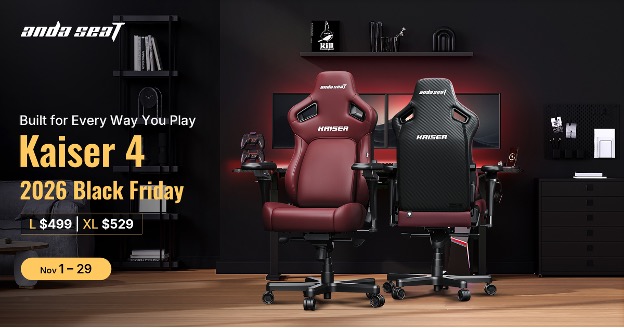
AndaSeat’s 2026 Black Friday campaign runs from November 1 through November 29. As part of the scheduled campaign, Kaiser 4 pricing is set at US$499 for size L and US$529 for size XL from November 1 .
About AndaSeat
Founded in 2007, AndaSeat develops ergonomic furniture and workspace products for gaming, professional and home environments. Its portfolio includes ergonomic chairs, standing desks, monitor arms and related workspace accessories. AndaSeat’s product-development approach combines structural engineering, adjustable ergonomics, material development and integrated workspace design, with a focus on how technology and furniture increasingly coexist within contemporary homes.
AndaSeat Marketing
AndaSeat
Visit us on social media:
LinkedIn
Instagram
Facebook
YouTube
TikTok
X
Legal Disclaimer:
EIN Presswire provides this news content "as is" without warranty of any kind. We do not accept any responsibility or liability for the accuracy, content, images, videos, licenses, completeness, legality, or reliability of the information contained in this article. If you have any complaints or copyright issues related to this article, kindly contact the author above.
